What is New about .NET 10: What is New, Which is Better and What is the Future Vision of Microsoft
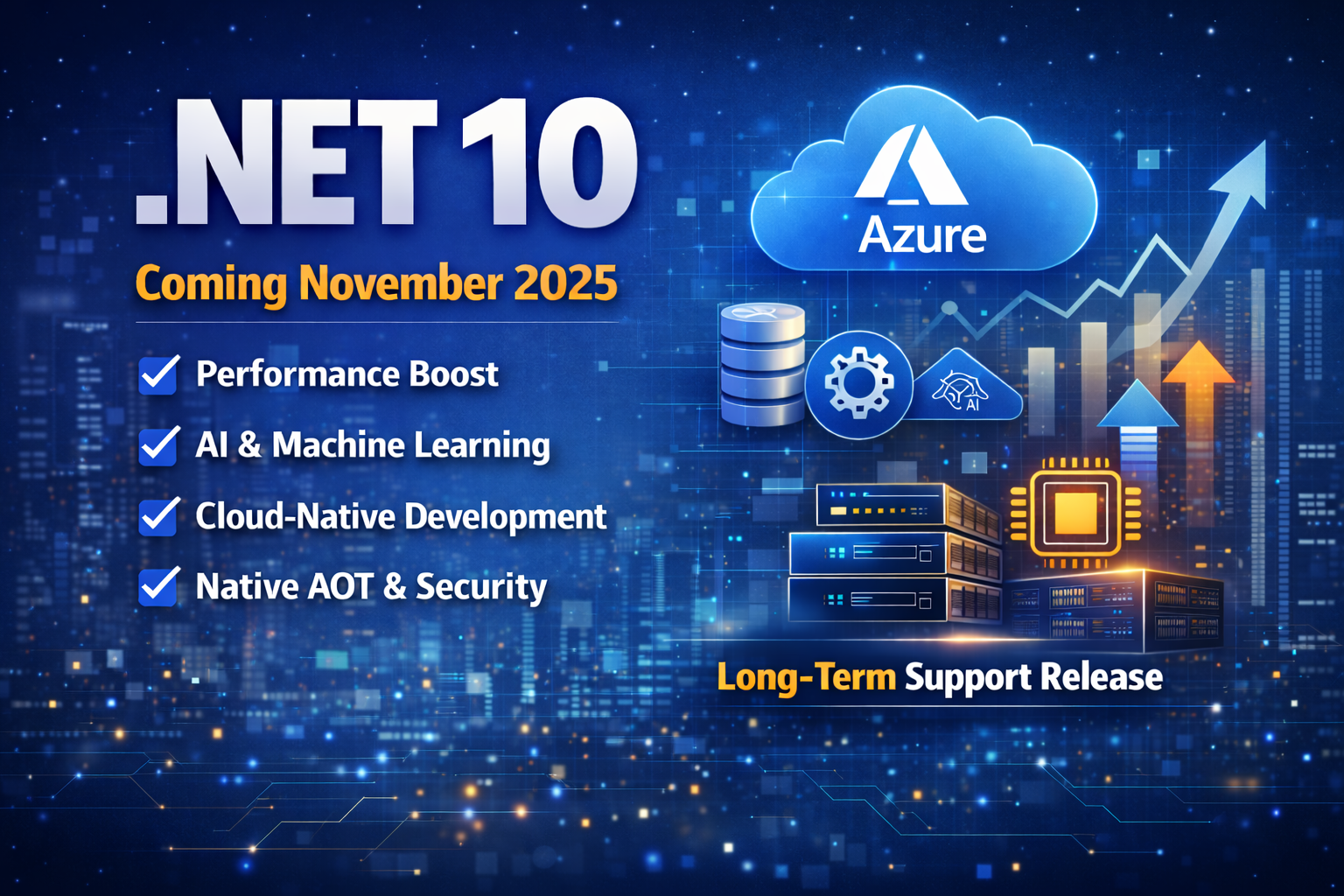
What's New in .NET 10? Features, Performance, AI and Cloud Improvements
People are really looking forward to some news in the software world, and that is the new .NET 10.
After Microsoft released the long-term support versions .NET 8 and .NET 9 of the .NET framework, they talked about what's coming next at a big conference called Microsoft Build. Microsoft said that the next long-term support version will be .NET 10 and it will come out in November 2025.
The .NET 10 is going to be a significant release because it is the next version of the .NET framework that people will use for a long time.
The new Microsoft Learn documentation and the dotnet/runtime GitHub repository have information about what's coming with .NET 10. It is designed to make applications work faster and provide improvements for people who build cloud-native applications. It will also be useful for developers who want to use Artificial Intelligence and improve their development workflows.
This article will tell you about the things in .NET 10. It will give you examples of how developers can use .NET 10, along with information about its performance, cloud, AI, security, and developer tooling improvements.
.NET 10 Release Timeline and LTS Support
Microsoft releases .NET every year. They also have something called LTS releases. These are versions such as .NET 6, .NET 8, and .NET 10. LTS versions receive long-term support from Microsoft.
This means that .NET 6, .NET 8, and .NET 10 receive updates and support from Microsoft for an extended period.
In Build 2024, the .NET team discussed the upcoming release cycle:
- .NET 9 – Standard release, November 2024
- .NET 10 – LTS release, November 2025
The official .NET release documentation provides current information about .NET versions and their support lifecycle.
People are also following development activity in the dotnet/runtime repository as Microsoft continues improving the platform.
Performance Improvements in .NET 10
People still care about performance. The new .NET 10 builds on improvements introduced in previous .NET releases.
Runtime and Just-in-Time Improvements
Expected areas of improvement include:
- Faster JIT compilation
- Improved loop optimization
- Fewer memory allocations
The performance of real-world applications such as ASP.NET Core APIs and microservices can benefit from runtime improvements.
Microsoft publishes detailed performance information through the official .NET Blog.
Garbage Collection Improvements
.NET continues to improve memory management through changes such as:
- Smarter background GC
- Reduced pause times
- Improved management of peak cloud workloads
These improvements are particularly relevant to enterprise applications and cloud workloads.
Cloud-Native Development Improvements
Cloud-native development is becoming increasingly important for modern applications. The .NET ecosystem continues to provide tools and capabilities designed for cloud-native workloads.
Microsoft is investing heavily in cloud development and Azure tooling. Developers can build applications that are designed to scale across modern cloud environments.
For businesses looking to build custom cloud-based applications, Software Development Services can be relevant.
ASP.NET Core Enhancements
ASP.NET Core is a major part of the .NET ecosystem and is widely used for modern web applications and APIs.
According to TechEmpower benchmarks, ASP.NET Core has demonstrated strong performance compared with other web frameworks.
Planned and ongoing improvements include:
- Enhanced minimal APIs
- Strengthened HTTP/3 support
- Enhanced rate limiting and monitoring
Businesses building modern web applications can also explore Web Development Services.
External reference: ASP.NET Core Documentation
Containers and Kubernetes
Based on .NET 8 changes, developers can benefit from improvements around:
- Smaller container images
- Faster startup times
- Better Native AOT support
These improvements reflect the needs of Docker and Kubernetes users and modern native deployment strategies.
External references:
.NET and Docker
Kubernetes Documentation
Native AOT and Cross-Platform Improvements
The biggest difference is that Native AOT continues to evolve. Introduced and improved in earlier .NET versions, Native AOT can help applications achieve faster startup and lower memory usage.
Benefits of Native AOT
- Improved performance
- Faster execution
- Near-instant startup
- Lower memory usage
- Support for customer-facing serverless and edge scenarios
These capabilities align with technologies such as Azure Functions, IoT, and Blazor hybrid applications.
External reference: Native AOT deployment overview
C# Language Enhancements with .NET 10
A new C# version is released alongside .NET releases. Modern C# development continues to focus on:
- Cleaner syntax
- Improved pattern matching
- Better async support
These ideas come from open C# discussions on GitHub, where developer feedback helps shape the language.
External reference: C# Language Reference
Machine Learning and AI Integration
Artificial Intelligence is now a core part of the Microsoft ecosystem.
ML.NET and AI SDK Improvements
With Azure OpenAI and tools like GitHub Copilot, .NET developers can build and integrate AI-powered applications.
.NET developers can explore technologies that:
- Improve ML.NET performance
- Provide better Azure AI integration
- Ease development of AI-based APIs
For businesses planning to build AI-powered applications, AI/ML Development Services can be relevant.
You can also explore Best AI Tools for .NET Developers.
External reference: Microsoft Azure AI
Development Products and Tools
Visual Studio and the .NET SDK continue to improve:
- Faster builds
- Smarter debugging
- Improved Hot Reload
At Build 2024, Microsoft announced SDK improvements and samples designed to make development workflows easier.
These changes are expected to continue as the .NET platform evolves.
External reference: Visual Studio
Security Enhancements
Due to increasing supply-chain security risks, Microsoft continues to emphasize:
- Dependency security
- Package validation
- Improved cryptography APIs
Modern .NET applications also benefit from security improvements involving:
- Better TLS handling
- Secure defaults
- Improved authentication middleware
These steps address security requirements across modern software ecosystems.
External reference: .NET Security Documentation
The Importance of .NET 10 for Businesses
.NET 10 is an LTS release designed for long-term application development, making it relevant for:
- Enterprise applications
- Government systems
- Large-scale SaaS platforms
Organizations evaluating migration to .NET 10 should consider their current .NET version, application dependencies, support requirements, and business needs.
For businesses developing or modernizing enterprise software, Software Development Services can support custom application development.
Final Thoughts
.NET 10 is an important release in the evolution of the .NET platform. Microsoft documentation, GitHub development activity, and previous releases show the continued focus on:
- Better performance
- Greater cloud-native capabilities
- Improved AI integration
- Long-term stability
For developers and businesses, .NET 10 represents Microsoft's continued focus on keeping .NET modern, high-performing, and suitable for modern application development.


Related Post

 February 02, 2026
Artificial Intelligence & Machine Learning for Business Growth
Artificial Intelligence, Machine Learning, AI and ML, AI in business, Machine learning in business, AI driven solutions, AI powered websites, AI website development, AI for business growth, AI automat...
Keep Reading January 17, 2026
GitHub and GitHub Co-pilot: A Comprehensive Guide, Analysis, and Future Outlook
GitHub and GitHub Copilot are transforming modern software development. Learn how AI-assisted coding improves productivity, collaboration, security, and future-ready development practices.
Keep Reading January 17, 2026
Best AI Tools for .NET Developers in 2025 (Boost Productivity & Code Quality)
Explore the best AI tools for .NET developers in 2025. Learn how GitHub Copilot, IntelliCode, ChatGPT, and other AI tools can boost productivity, streamline coding, and improve code quality in Visual ...
Keep Reading